OpenStreetMap store locator: how it works, its limits, how it looks
An OpenStreetMap store locator shows your shops without a Google Maps API key. Here is how the map is built, what the ODbL licence asks of you, where the tile servers set limits, and what it looks like on a storefront.
An OpenStreetMap store locator shows your shops on a map drawn from OpenStreetMap data instead of Google Maps. Several Shopify apps now work this way, and their listings open with the same promise: no API key required. Before you pick one, it helps to know what OpenStreetMap is, what its licence asks of you, where its limits sit, and what the result looks like on a storefront.
OpenStreetMap, a map made by its contributors
OpenStreetMap (OSM) is a map of the world built by its contributors. The OpenStreetMap Foundation (OSMF) publishes the data as open data under the Open Data Commons Open Database License (ODbL).
The OpenStreetMap copyright page sums up what that allows: you are free to copy, distribute, transmit and adapt the data, as long as you credit OpenStreetMap and its contributors. No single company sells access to it, so any developer can build a map on top of it without opening an account.
How a store locator uses OpenStreetMap
A store locator built on OSM relies on two layers. The first is the map data that contributors maintain. The second is the rendered tiles: small square images that a tile server draws from that data and sends to the browser for each zoom level.
A JavaScript library then assembles everything on your page. Leaflet, an open-source library for interactive maps, is one of them: it requests the tiles, places your pins on top, and handles zoom when the visitor moves around the map.
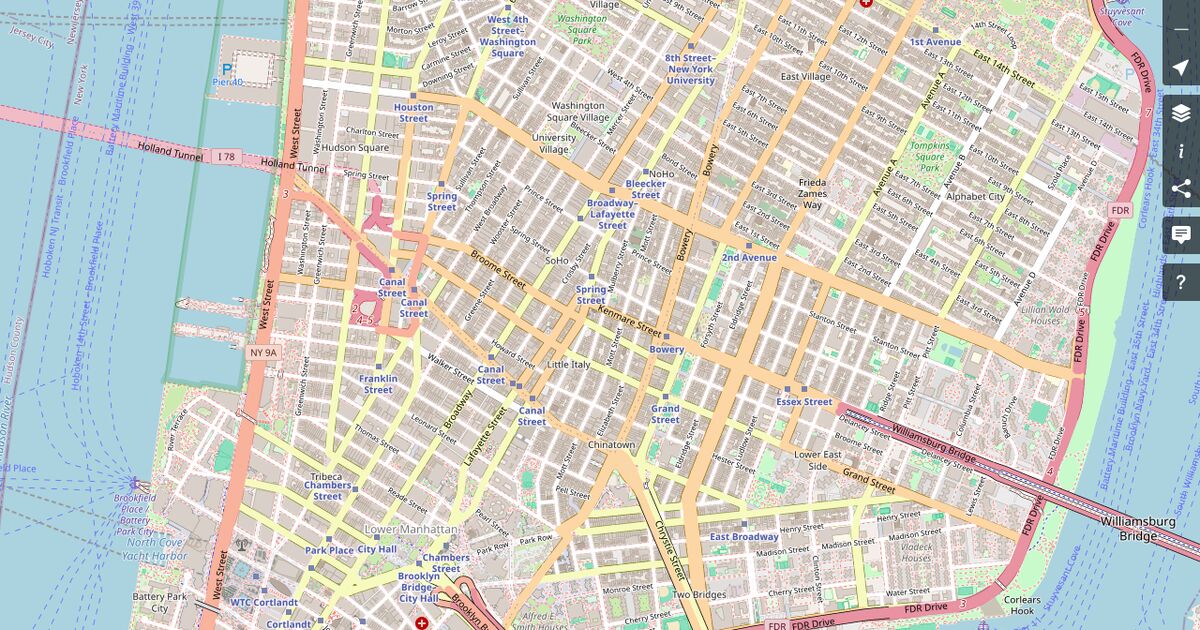
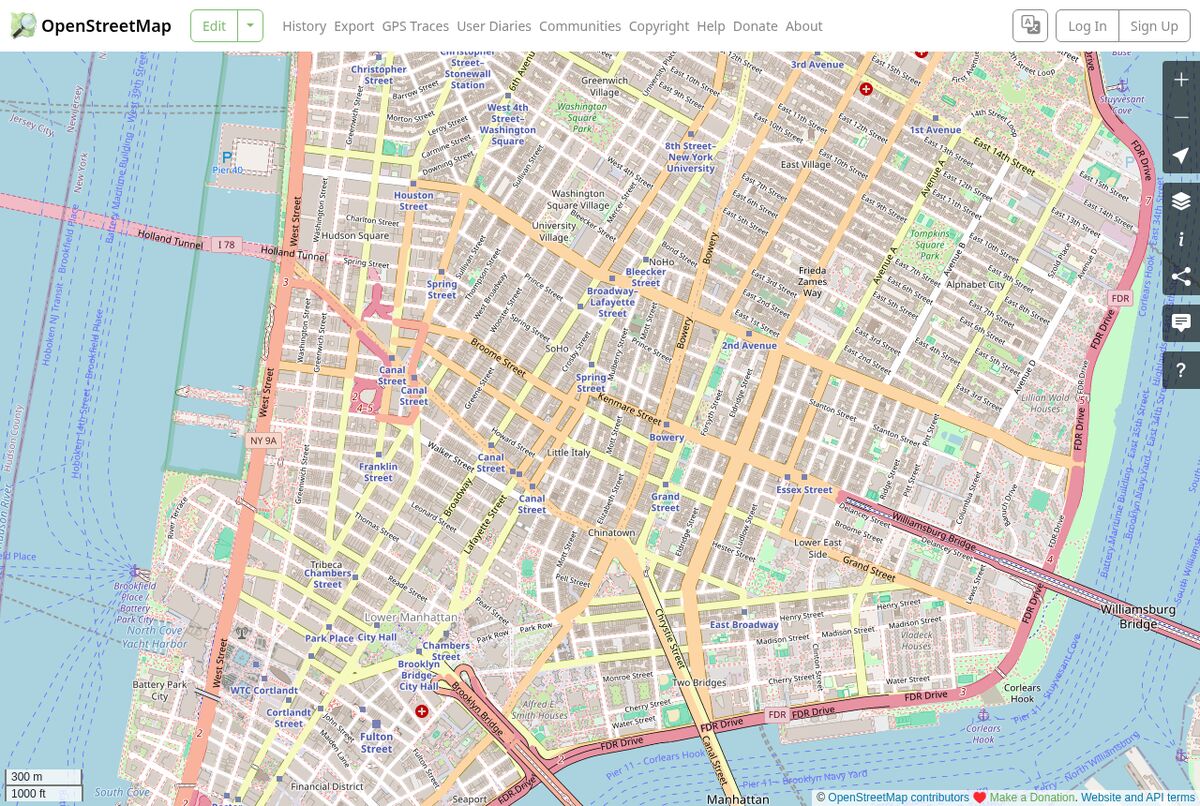 Lower Manhattan on openstreetmap.org, with the attribution notice in the bottom-right corner. Source: openstreetmap.org, captured September 18, 2026.
Shops already mapped in OSM
OSM also stores shops itself. Contributors describe them with the shop key, so a shop can already appear on the public map as a point of interest.
Your store locator does not read those tags. It displays your own list of locations, with the addresses and opening hours you entered, and uses OSM as the background map. If a stockist moves, you update your list, and the locator follows.
The ODbL licence and the attribution notice
The ODbL attaches two obligations to the data, both listed on the copyright page:
- display an attribution notice that credits OpenStreetMap and its contributors;
- make clear that the data is available under the ODbL.
The OSMF Attribution Guidelines, which the Foundation's board adopted on June 25, 2021, add one more point: the attribution must be presented to anyone who views or interacts with the map. It typically takes the form of a short "© OpenStreetMap contributors" notice in a corner of the map. You can see it at the bottom right of the screenshot above.
If you customize your locator page, keep that notice visible. Hiding it with CSS to tidy the design breaks the licence terms.
The limits of the public tile servers
The data costs nothing, and the servers that draw the tiles follow different rules. The OSMF Tile Usage Policy states that OSM data is free for everyone but that its tile servers "are not". Donations and sponsorship fund them, and their capacity is limited.
The policy spells out what that means for anyone who builds on tile.openstreetmap.org:
- the service runs on a best-effort basis, with no service level agreement;
- the Foundation can block heavy use without notice;
- requests must come with visible attribution, a valid User-Agent and a Referer.
The policy asks heavy users to move to a service derived from OSM or to run their own tile server. The OSMF finances page shows where the money comes from: donations and membership provide most of the Foundation's income.
As a merchant, do not point a busy storefront at the public OSM tile servers yourself. Store locator apps serve the maps for you, which keeps your traffic off a service that runs on donations.
OpenStreetMap next to Google Maps
Our guide to Google Maps API keys covers the switch in detail: an OpenStreetMap locator needs no API key, no cloud project and no billing account, and a traffic spike costs you nothing. Here is the short version of the trade.
The gain shows on the bill. Google's Maps Platform pricing gives Dynamic Maps 10,000 free map loads per month, then charges $7.00 per 1,000 loads up to 100,000, and $5.60 per 1,000 from 100,001 to 500,000. An OpenStreetMap locator served by an app has no per-load bill and no card on file with Google. Google's Maps Embed, the iframe that Shopify's help center shows you how to paste into a page, carries no charge and has an unlimited free usage cap.
The loss sits in Google-specific services such as Street View, and in the look of the map. OSM tiles do not look like Google Maps, and your visitors may notice. Judge it on your own ground: open both maps on the streets where your stores sit and compare.
Shopify apps built on OpenStreetMap
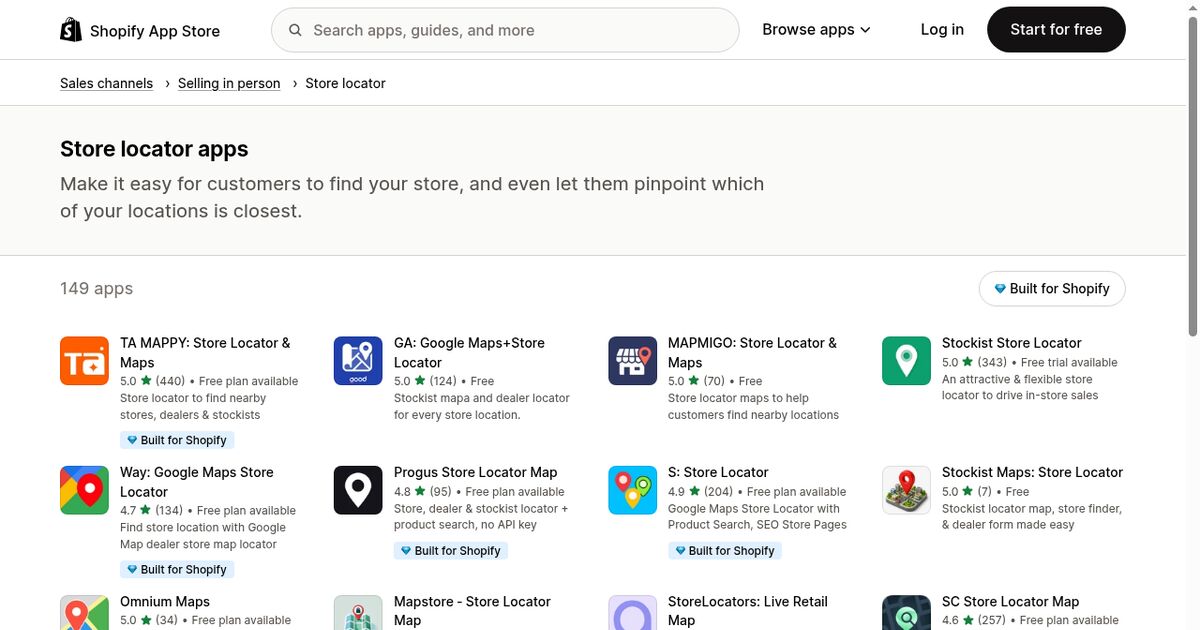
Several App Store listings state that they work without a Google key (listings read on September 18, 2026):
- TA MAPPY: the free plan runs on OpenStreetMap, with no API key required.
- Progus: "No API key required".
- Stockist Maps: Store Locator: "No API key required with Leaflet, plus Mapbox and Google Maps support", rated 5.0 from 7 reviews.
- Easy Google Maps Store Locator: "No API key is required with OpenStreetMap maps".
Compare the plans, the location caps and the map options on each listing. If budget drives your choice, our guide to a free store locator on Shopify covers the no-cost options.
How it looks in Locastore
Locastore draws its map with Leaflet and OpenStreetMap tiles. You create no Google Maps API key, open no billing account and watch no quota. The map library and the tiles load only on the page that holds the Store Locator block, and Shopify's app proxy serves your locations with a 60-second cache.
Visitors search a city or tap "Near me", see distances in kilometres or miles, and get an open/closed badge that the widget computes from your opening hours. A directions link opens the route in Google Maps. Marker clustering groups nearby pins, and tag filters narrow the list.
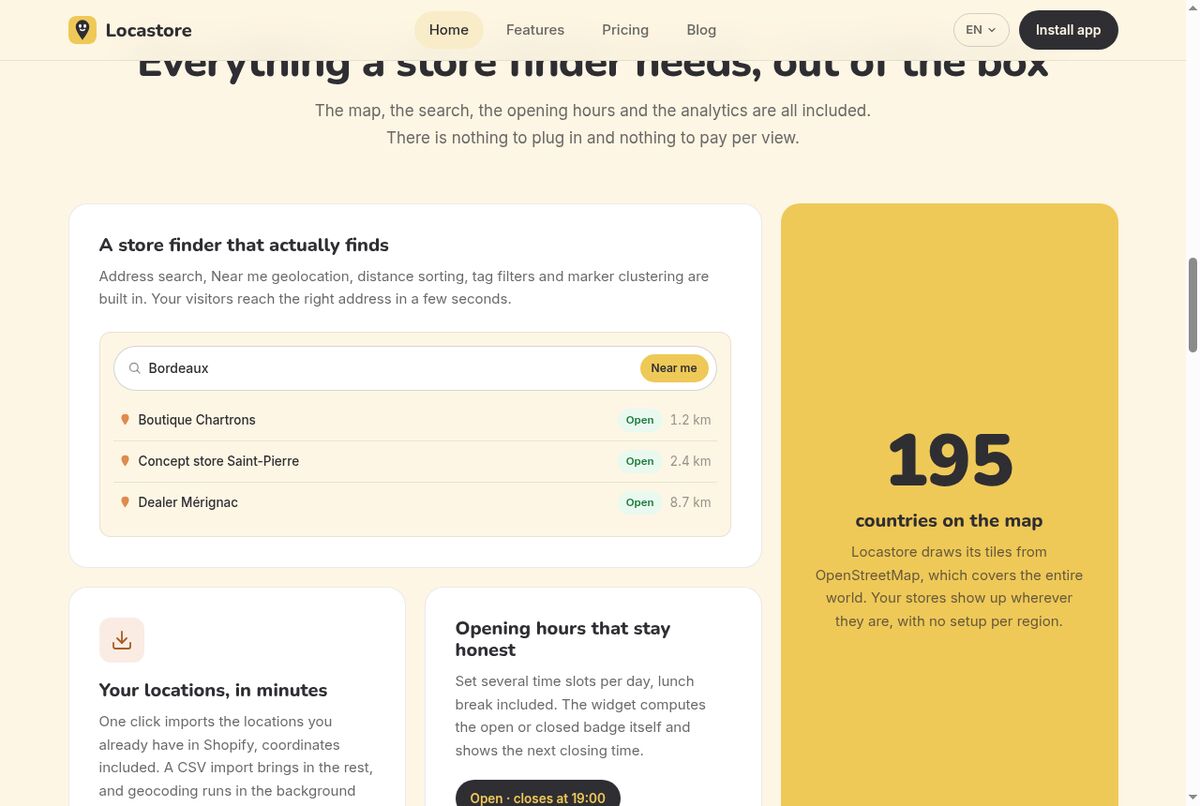 The store finder section of the Locastore home page, with search, "Near me", open badges, distances and "195 countries on the map". Source: locastore.app, captured September 18, 2026.
Your locations come from your own data. You can import your Shopify locations in one click, with their coordinates, upload dealers and stockists from a CSV file, or type an address by hand. Locastore geocodes each address, and you can drag a pin on a mini map in the admin to correct its position.
You add the Store Locator block from the theme editor on any page, then set the layout, the map style, your brand color and the labels. The app offers six display modes and four map styles.
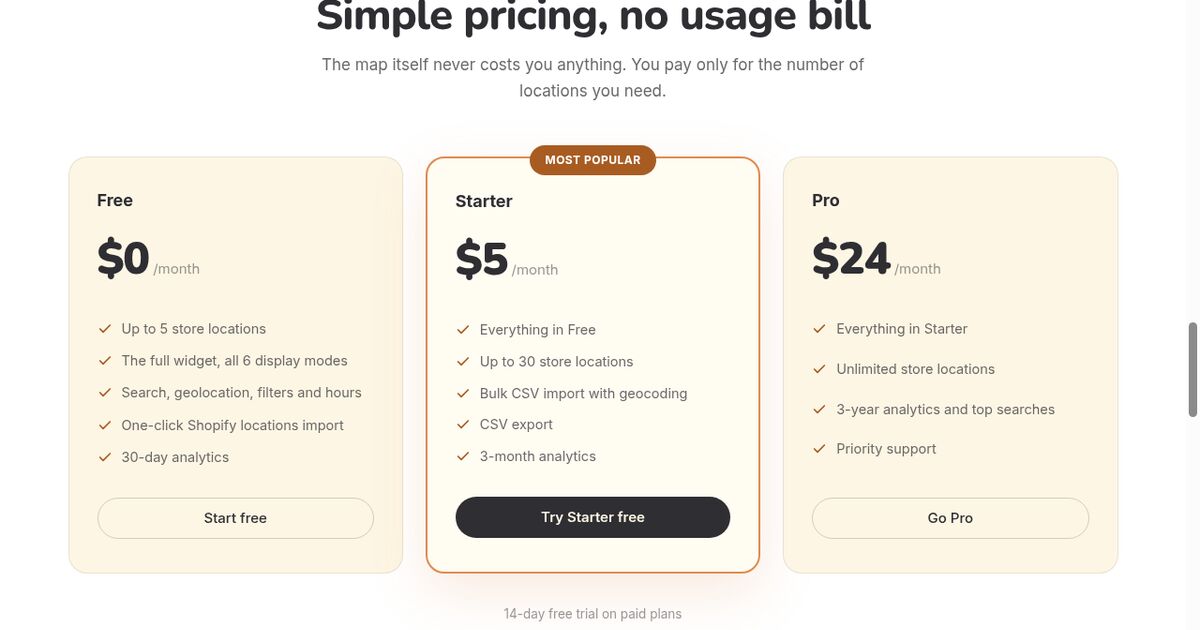
Locastore puts an OpenStreetMap store locator on your Shopify storefront, with no Google key and no map bill. The free plan covers up to 5 store locations, Starter ($5 per month) goes up to 30, and Pro ($24 per month) removes the limit, with a 14-day free trial on paid plans.
Frequently asked questions
Is OpenStreetMap as good as Google Maps?
They come from different providers. OpenStreetMap is open data built by a community of contributors, with worldwide coverage, while Google adds its own services such as Street View. The simplest test is to open both maps on the cities where your stores are and compare them yourself.
Is OpenStreetMap totally free?
The data is free to use under the ODbL, as long as you credit OpenStreetMap and its contributors. The public tile servers are a different case: donations and sponsorship fund them, their capacity is limited and they come with no service level agreement. Heavy users should switch to an OSM-derived service or run their own.
Who pays for OpenStreetMap?
The OpenStreetMap Foundation gets most of its income from donations and membership. The welcome panel on openstreetmap.org states that Fastly, OSMF corporate members and other partners support its hosting.
Do I need to credit OpenStreetMap on my store locator?
Yes. The licence requires a visible attribution, and the OSMF guidelines say it must reach anyone who views or interacts with the map. It typically appears as the "© OpenStreetMap contributors" notice in a corner of the map.