Google Maps API pricing in 2026: what a store locator costs
Google Maps Platform bills each SKU per 1,000 events after a free monthly cap. Here are the caps, the prices a store locator page triggers, a worked example at 5,000, 20,000 and 50,000 map loads, and how to keep the bill under control.
Google Maps API pricing works per SKU: each service has a free monthly usage cap, then Google charges a price per 1,000 billable events. For a store locator, the main line is Dynamic Maps, with 10,000 free map loads per month and $7.00 per 1,000 loads beyond that, up to 100,000.
This guide covers the caps Google introduced in March 2025, the SKUs a store locator page actually triggers, a worked example at three traffic levels, and the settings that keep a surprise bill off your card.
The March 2025 change: free caps replace the $200 credit
Until February 28, 2025, Google gave each billing account a USD 200 monthly credit, applied automatically to qualifying SKUs. The March 2025 changes page states that, as of March 1, 2025, Google replaced that credit with a free monthly usage threshold for each Core Services SKU.
Google also sorted its services into three categories, and the free amount depends on the category. The billing FAQ lists them:
| Category | Free monthly billable events per SKU |
|---|---|
| Essentials | 10,000 |
| Pro | 5,000 |
| Enterprise | 1,000 |
The FAQ adds one exception: Map Tiles API 2D Map Tiles and Street View Tiles get 100,000 free monthly events. You can mix SKUs from different categories, and each one counts against its own cap.
The same change expanded automatic volume discounts. Most Core Services SKUs now get cheaper per event as monthly volume grows, in tiers that scale to 5,000,000+ billable events, up from 100,000+ before March 2025.
Many blog posts about Google Maps cost still compute their figures with the old $200 credit. If an article mentions that credit as current, its numbers no longer match your bill.
What a store locator page consumes
A store locator rarely calls only one Google service. Depending on how the app or developer built it, a single page can trigger several SKUs, and each one has its own cap and its own price.
The map itself: Dynamic Maps
Google's Maps JavaScript API billing page explains that map loads trigger the Dynamic Maps SKU, and that Google bills Dynamic Maps per load. Every time a visitor opens your locator page and the interactive map loads, that counts as one event.
Panoramas trigger a separate SKU, Dynamic Street View, which sits in the Pro category. Calls to the Places Library are priced separately from the map.
Store addresses and visitor searches: Geocoding
Geocoding turns an address into coordinates. A locator needs it for your store addresses, and often for the city or postcode a visitor types into the search box. The Geocoding API billing page says each request is billed under the Geocoding SKU.
Your store addresses only need geocoding once, if the tool saves the coordinates. Visitor searches repeat every day, so they make up most of the geocoding line.
The search box: Places Autocomplete
If the search box suggests addresses as the visitor types, it calls Places Autocomplete. In the Places API (New), Google lists Autocomplete Requests as an Essentials SKU with a 10,000 free cap, and Autocomplete Session Usage with an unlimited free cap. The Maps JavaScript API page recommends sessions when your monthly volume reaches 100,001 to 500,000 calls or when users make more than 12 autocomplete requests per session.
The free option: Maps Embed
The Maps Embed API is free to use with unlimited requests, and Google states there are no daily or rate limits on it. It still requires an API key. Our walkthrough on how to add a Google map to Shopify covers that setup.
Google Maps API prices per 1,000 events
Google publishes its prices in the core services pricing list. All prices are in USD, per 1,000 events, and the ranges count monthly events. Here are the SKUs a store locator is most likely to trigger, with the first two paid tiers:
| SKU | Category | Free monthly cap | Up to 100,000 | 100,001 to 500,000 |
|---|---|---|---|---|
| Dynamic Maps | Essentials | 10,000 | $7.00 | $5.60 |
| Geocoding | Essentials | 10,000 | $5.00 | $4.00 |
| Autocomplete Requests | Essentials | 10,000 | $2.83 | $2.27 |
| Autocomplete Session Usage | Essentials | Unlimited | - | - |
| Embed | Essentials | Unlimited | - | - |
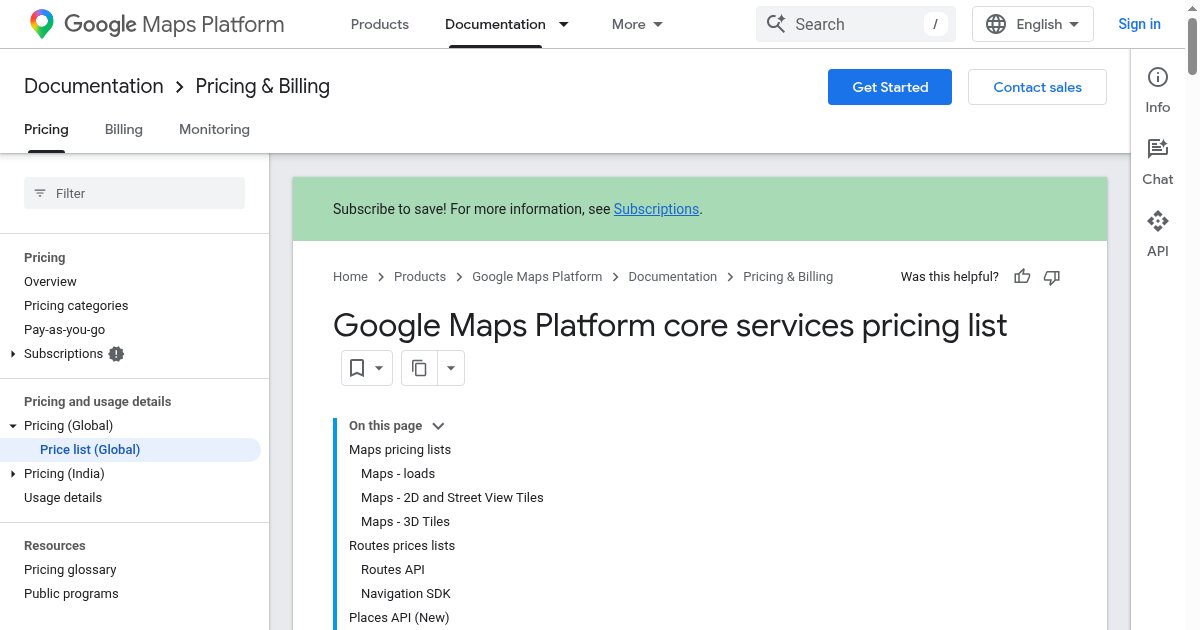
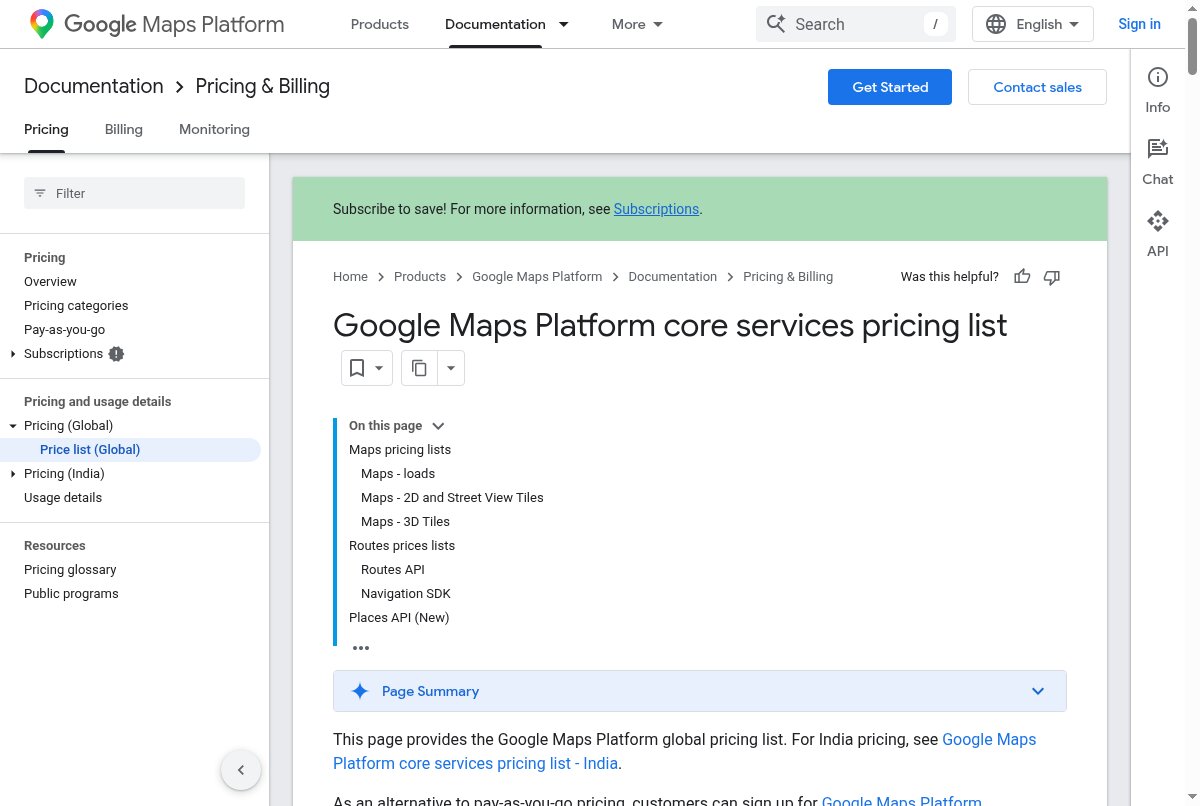 The Google Maps Platform core services pricing list, with its table of contents for Maps loads, 2D and Street View tiles, Routes and Places. Source: developers.google.com, captured October 26, 2026.
Google applies the free cap first, then each tier to the events that fall inside it. The pricing list gives its own example: 200,000 Autocomplete Requests in one month cost $0 for the first 10,000, $254.70 for the next 90,000 and $227.00 for the following 100,000, a total of $481.70.
The page summary also warns that upcoming changes include adjustments to discounts and credits, with some services moving to Legacy status. Prices move, so check the official list on the day you budget.
Worked example: map loads on a locator page
This estimate covers one SKU, Dynamic Maps, and assumes the locator loads one map per page view. It uses only the 10,000 free cap and the $7.00 per 1,000 price from Google's list, since every scenario stays under 100,000 loads.
| Monthly page views | Billable map loads | Calculation | Monthly cost |
|---|---|---|---|
| 5,000 | 0 | under the 10,000 free cap | $0.00 |
| 20,000 | 10,000 | 10,000 / 1,000 x $7.00 | $70.00 |
| 50,000 | 40,000 | 40,000 / 1,000 x $7.00 | $280.00 |
Geocoding and autocomplete add their own lines on top. If your locator geocodes each visitor search, 20,000 searches in a month leave 10,000 billable requests after the free cap, which at $5.00 per 1,000 adds $50.00. Each SKU keeps its own cap, so the free 10,000 map loads do not cover geocoding.
Google aggregates usage across all projects linked to the same billing account to pick the pricing tier. If another site or app shares that billing account, its usage counts toward the same tiers.
At high volume the tiers matter more. Google's March 2025 page gives a Geocoding example: a customer with 2,000,000 monthly requests paid $7,900 per month before March 1, 2025, and $5,050 after, thanks to the free requests and the expanded discounts.
What you need even under the free cap
The free cap does not remove the setup. The Maps JavaScript API page says you must enable billing on each project and include an API key or OAuth token with all requests. The Geocoding API page sets the same rule, and the Maps Embed API requires an API key. So you open a Google Cloud project, attach a billing account with a card, and create a key, even if your bill stays at $0.
The one exception is testing: Google offers a Maps Demo Key that lets you try select Maps JavaScript API and Places UI Kit features with no billing information.
Our guide to Google Maps API keys for a store locator walks through the key itself and how to restrict it.
How to cap your Google Maps spending
Google gives you two levers, both in the Google Cloud Console.
- Budget alerts. The billing FAQ points to Google's guides on budget alerts and usage caps. You set an amount, and Google warns you as spending approaches it. An alert leaves the service running.
- Quotas. You can lower the daily quota of an API, such as Geocoding, from Google Maps Platform > Quotas. When your project reaches the quota limit, the service stops responding to requests. Daily quotas reset at midnight Pacific time.
A quota protects your card and breaks your locator for the rest of the day when traffic spikes. Pick the limit with that in mind. Google also sets its own ceilings: the Maps JavaScript API allows 30,000 map loads per minute per project and 300 per minute per IP.
Store locators that skip Google billing
A store locator can draw its map without any Google SKU. OpenStreetMap provides open map data, and a library such as Leaflet assembles the tiles and your pins on the page. Our OpenStreetMap store locator guide explains how that works, what the licence asks of you and where the public tile servers set limits.
With that setup, you create no Google API key, attach no billing account and watch no quota. You can still give visitors a directions link that opens the route in Google Maps.
Locastore: a store locator with no Google Maps bill
Locastore is a Shopify app that shows your stores, dealers and stockists on a map inside your storefront. It draws the map with Leaflet and OpenStreetMap tiles, so you need no Google Maps API key, no billing account and no quota. You import your Shopify locations in one click with their coordinates, upload a CSV file that Locastore geocodes in the background (Starter and up), or enter addresses by hand. Visitors search an address, tap "Near me", sort by distance and open directions in Google Maps.
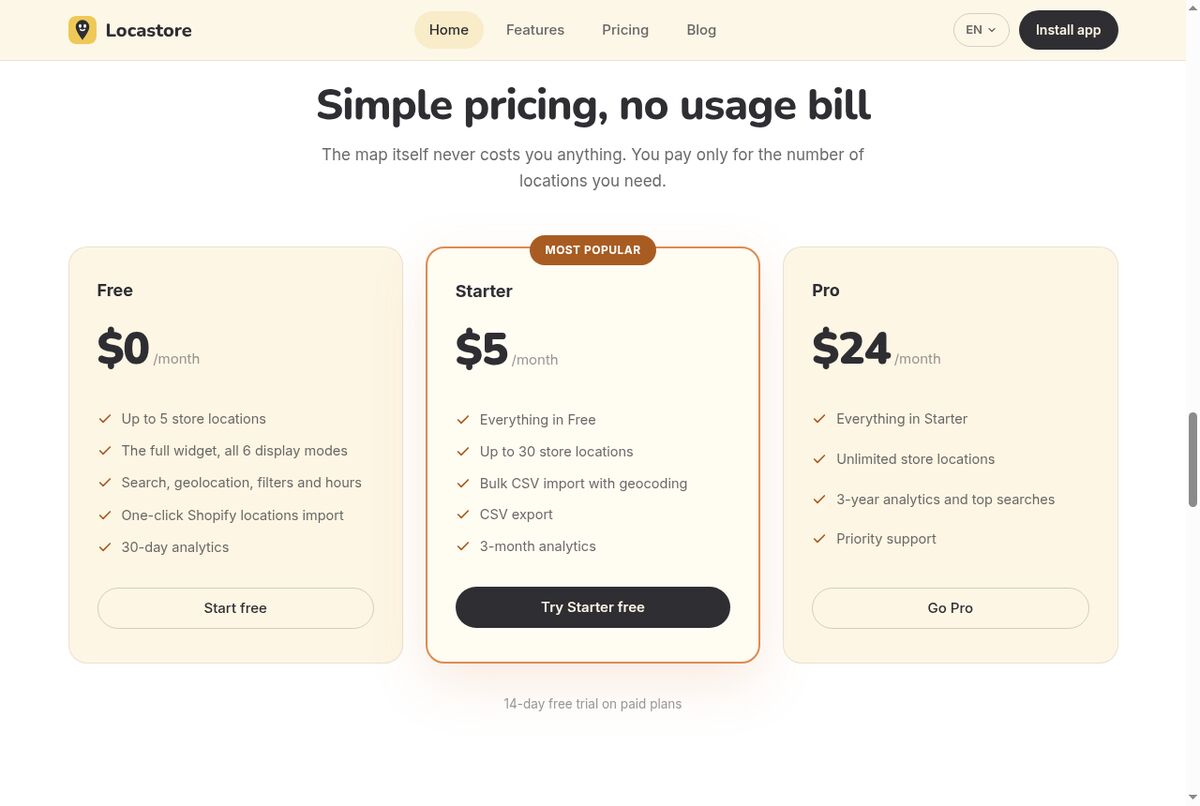 The Free, Starter and Pro plans on the Locastore pricing page. Source: locastore.app, captured October 26, 2026.
The Free plan covers up to 5 locations with the full widget, Starter ($5 per month) goes up to 30 locations with bulk CSV import, and Pro ($24 per month) removes the limit, with a 14-day free trial on paid plans. For more no-cost options, see our guide to a free store locator on Shopify.
Frequently asked questions
Is the Google Maps API free?
Partly. Since March 1, 2025, each Core Services SKU comes with a free monthly usage cap: 10,000 billable events for Essentials SKUs, 5,000 for Pro and 1,000 for Enterprise. Beyond the cap, Google charges per 1,000 events. The Maps Embed API carries no charge and has unlimited free usage.
How much does Google Maps cost per 1,000 map loads?
Google's global price list gives Dynamic Maps, the SKU behind a Maps JavaScript API map, 10,000 free loads per month, then $7.00 per 1,000 loads up to 100,000 and $5.60 per 1,000 from 100,001 to 500,000. Check the official list before you budget, since Google adjusts discounts and SKUs.
Do I need a billing account if I stay under the free cap?
Yes. Google's documentation for the Maps JavaScript API and the Geocoding API says you must enable billing on your project and include an API key or OAuth token with every request. The Maps Embed API also requires an API key. Only the Maps Demo Key lets you try select features with no billing information.
Is there a free alternative to the Google Maps API for a store locator?
Yes. A store locator can draw its map with OpenStreetMap data and a library such as Leaflet. That setup uses no Google SKU, so it needs no Google API key, no billing account and no quota.